
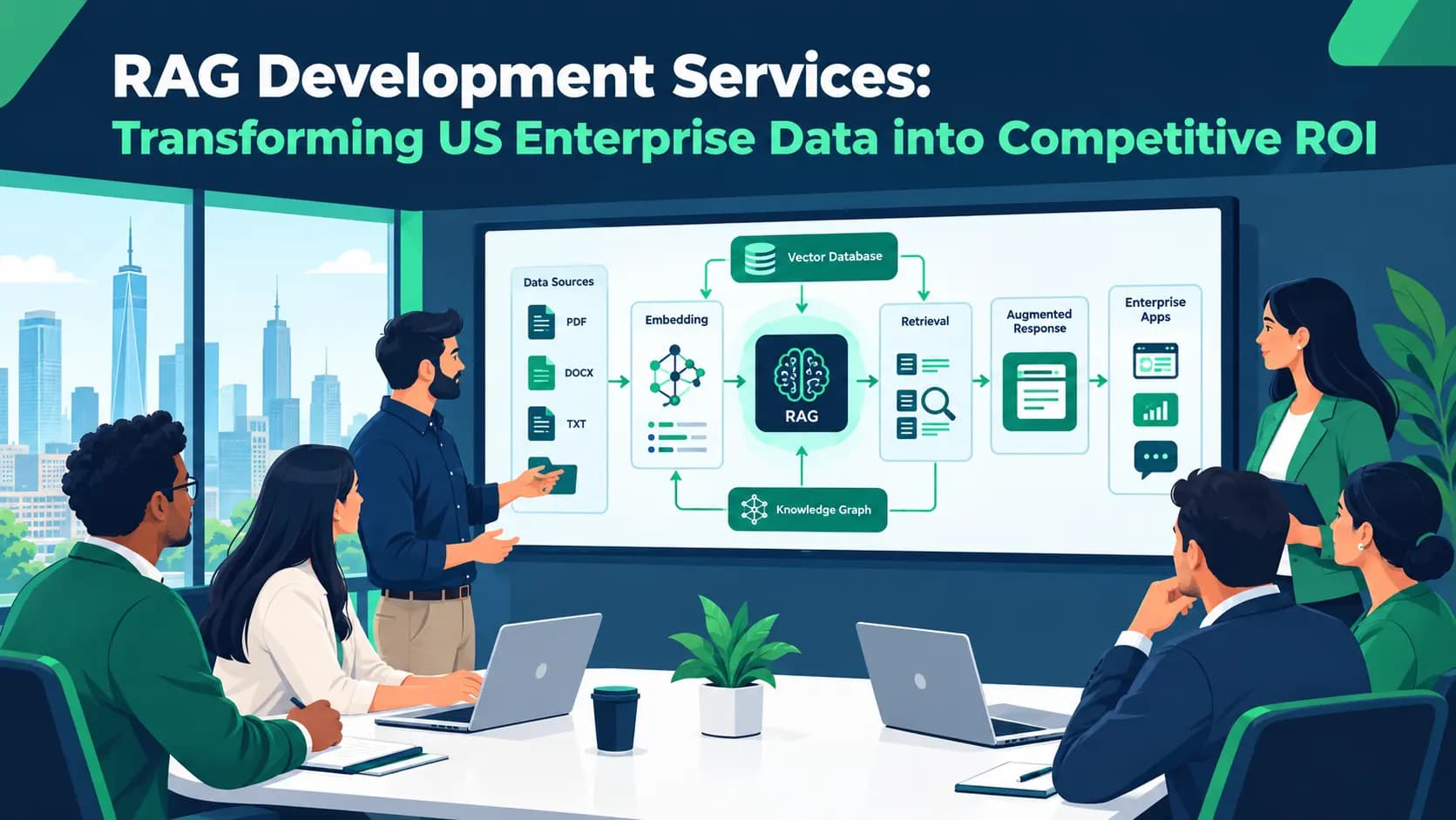
RAG Development Services: Transforming US Enterprise Data into Competitive ROI
Most US enterprises don't have a data shortage. They have a retrieval problem. Years of contracts, support tickets, internal wikis, compliance documents, and product manuals are sitting in different systems, and almost none of it talks to the AI tools employees are now expected to use.
This is exactly the gap that RAG development services are built to close. Instead of asking a language model to "know everything," RAG connects it to the specific documents your company already trusts, so answers come from your own data instead of a guess.
Quick answer: RAG development services combine retrieval systems with large language models so AI outputs are grounded in an organization's actual documents, not general internet knowledge. For US enterprises, this typically means faster access to internal knowledge, fewer inaccurate answers, and AI tools that hold up under real business use instead of falling apart outside a demo. Done well, it turns previously unsearchable internal data into something closer to a working knowledge system.
Why 2026 Looks Different From the First Wave of RAG Projects
A lot of companies built their first RAG system in 2024 or 2025, got it working in a demo, and then watched it struggle once real employees started using it. That's a pattern we've seen play out again and again.
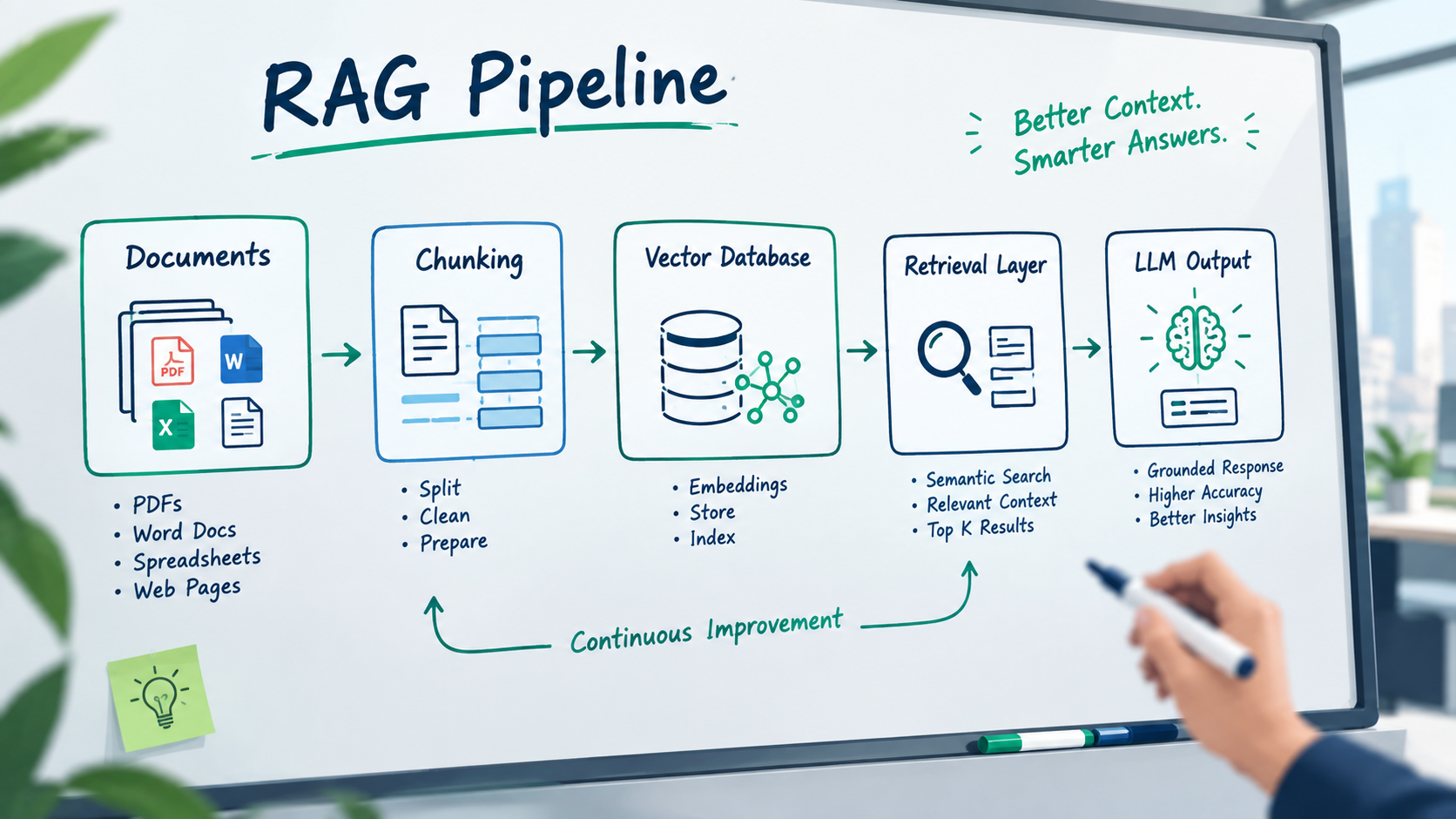
The issue usually wasn't the language model. It was everything underneath it: chunking strategy, retrieval quality, and how well the system handled messy, inconsistent internal documents. Enterprises are now going back and rebuilding that layer instead of replacing the model on top of it.
There's also a shift happening in what "good enough" retrieval means. Simple keyword or vector search alone is increasingly treated as a starting point, not the finish line. More teams are combining multiple retrieval methods together to get answers that actually hold up under scrutiny.
What Makes Enterprise RAG Development Different From a Basic Chatbot Project
Scale changes the math completely. A demo working on fifty documents tells you almost nothing about how it'll behave across fifty thousand, spread across different formats, departments, and update schedules.
Enterprise RAG development also has to deal with permissions. Not every employee should retrieve every document, and a system that ignores this is a compliance risk waiting to happen, especially in finance, healthcare, or legal-adjacent industries.
Here's where a lot of teams get this wrong: they treat RAG as a one-time build instead of a system that needs monitoring, retraining, and re-indexing as source documents change. A RAG development company that treats this as "ship and forget" is setting a client up for a slow decline in answer quality over the following months.
The RAG Development Cost Question Nobody Answers Honestly
Most vendors avoid giving a straight answer on RAG development cost, and part of that is fair. A project connecting to three clean data sources is a very different scope than one pulling from twenty legacy systems with inconsistent formatting.
That said, cost conversations should happen early, not after a proposal. A serious RAG development company will walk through data volume, source complexity, security requirements, and expected query load before giving you a number, rather than quoting a flat package price that ignores all of it. For a sense of how these numbers typically break down, our AI agent development company cost guide covers similar cost drivers, since RAG and agentic AI projects tend to scope out the same way.
It's also worth asking what's included after launch. Ongoing re-indexing, monitoring, and retrieval tuning are recurring work, not a one-time cost, and any quote that doesn't mention this is incomplete.
Common RAG Use Cases Turning Into Real ROI
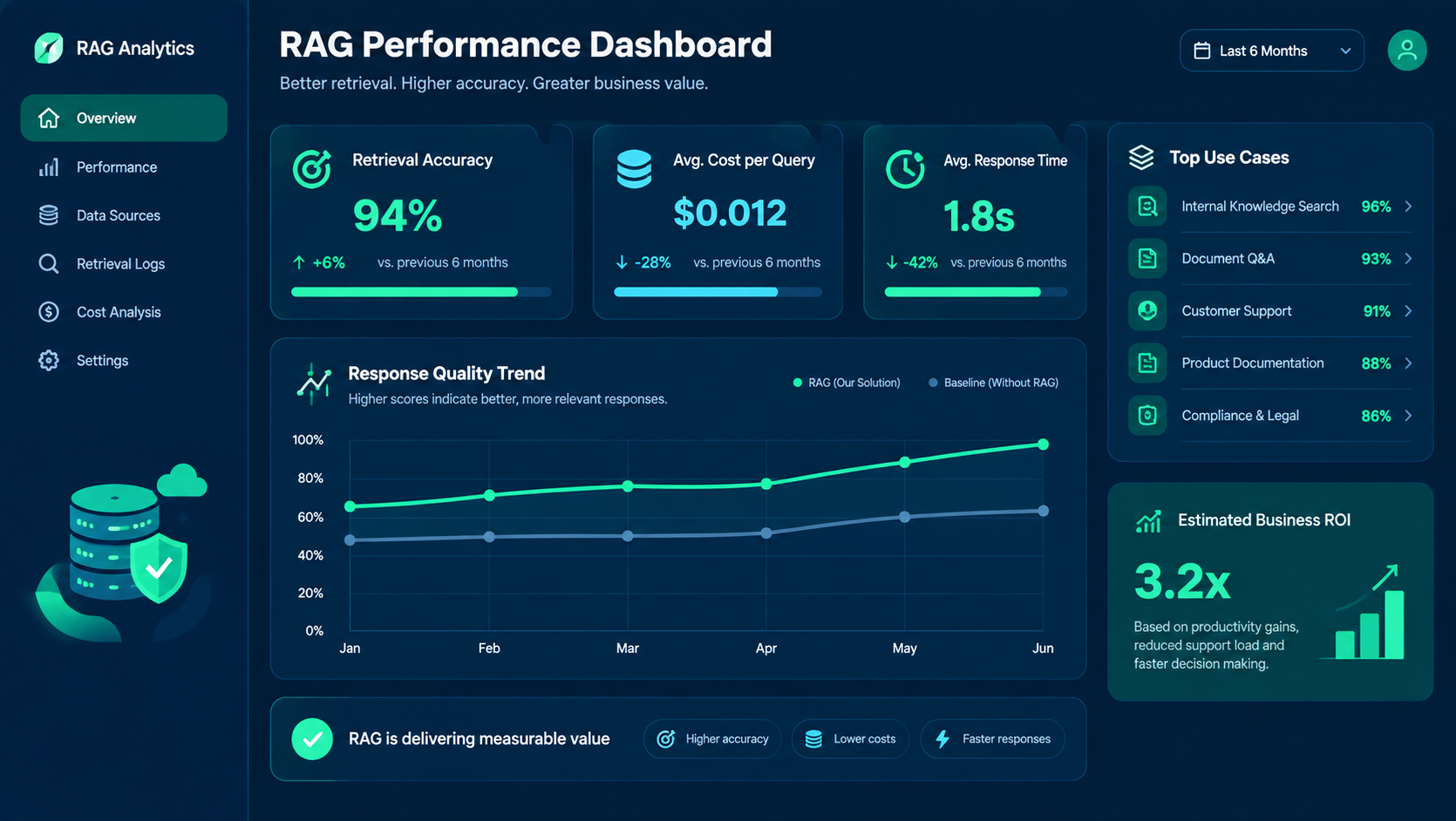
Internal knowledge search is the most common starting point: support teams, sales reps, and engineers pulling accurate answers from internal documentation instead of pinging a colleague or digging through folders. It sounds simple, but the time saved adds up fast across a large team.
RAG chatbot development for customer-facing support is another strong use case, particularly when paired with strict guardrails so the system only answers from approved content. Compliance and audit teams are also using RAG to search through dense regulatory documents faster than manual review ever allowed.
A newer pattern we're seeing involves combining retrieval with automated actions, not just answering a question, but triggering a workflow based on what was found. That overlaps closely with agentic AI workflows, where retrieval feeds directly into an action the system takes on its own. If you're new to that side of things, our step-by-step guide to creating an AI agent is a useful starting point, and our breakdown of AI agent ROI walks through what companies actually get back from that kind of investment.
Where Custom RAG Development Services Go Wrong
The most frequent mistake is picking the retrieval architecture before understanding the actual documents. Vector search alone works fine for some content and poorly for other content, particularly anything table-heavy or highly structured like financial statements.
Another mistake, and one that's easy to miss, is treating evaluation as optional. Without a real way to measure whether retrieved answers are accurate, teams end up guessing whether the system is actually working, which is a bad place to be once it's touching customer-facing decisions.
Security is often bolted on at the end instead of designed in from the start. That's backwards, and it usually shows up later as a painful, expensive retrofit.
What This Looks Like With Toadster
We approach RAG development services by starting with the data itself, not the model. That means understanding document structure, access requirements, and how information actually gets used before deciding on architecture, all part of the broader AI development work we do for clients.
Our enterprise RAG development team builds systems designed to be monitored and adjusted after launch, not left alone once they're live. As an AI development company working with US enterprises, we've seen how much of RAG's real value shows up months after launch, not on day one. For clients who want retrieval paired with automated workflows, we also bring in agentic capabilities so the system doesn't just answer questions but can act on what it finds.
Getting This Right Matters More Than Getting It Fast
The companies seeing real returns from RAG aren't the ones who moved fastest. They're the ones who took the data seriously before touching the model. If your internal knowledge is scattered across systems that don't talk to each other, that's usually the actual problem worth solving first.
If you want to talk through what a RAG system could look like for your organization, get in touch with us.