
What does AI workflow automation actually replace?
The honest answer is: the work that fills mornings before the real work starts. Data entry between systems that don't talk to each other. First-response emails that follow the same structure 90% of the time. Approval chains where someone just needs to forward a form. Compliance checks that could run on a schedule but instead wait for a human to remember them. None of it requires deep expertise. All of it takes time. And when you add it up across a team of 20, you're often looking at 30 or 40 hours a week that evaporate into coordination overhead rather than output. What's changed is that AI can now handle sequences, not just isolated steps. A customer sends a refund request. The AI reads the message - even if it's badly written or emotionally charged - pulls the order history, checks the return policy, calculates the amount, processes it, and sends a confirmation. A human only gets involved if something unusual flags. That entire chain used to require at least 3 people. Now it requires a well-designed system and an occasional override. Natural language processing is what makes this possible at the edges. It doesn't need the customer to fill out a form in the right format. It figures out what they mean and acts on it. That tolerance for real-world messiness is the actual leap - not the automation itself, but the ability to handle inputs the way humans arrive at them. > "The companies doing this well aren't trying to remove people from the equation. They're removing the parts of the job that grind people down."Real companies, real results - what's actually happening
Klarna's AI assistant, built on OpenAI's technology, took on the customer service workload equivalent of 700 full-time agents. Resolution time dropped from an industry average of 11 minutes to under 2. Customer satisfaction didn't fall - it held. That's not a pilot. That's a structural shift in how a major financial services company operates. Microsoft's Copilot, embedded across its enterprise products, is saving knowledge workers 2 to 3 hours per week on average - document summaries, email drafts, meeting notes. Across a 10,000-person organisation that's a serious shift in productive capacity, delivered without hiring a single additional person. Shopify runs fraud detection, merchant support triage, and logistics coordination through AI systems that process millions of decisions daily. NVIDIA uses machine learning automation in its supply chain at a speed and complexity no manual team could replicate. These aren't edge cases - they're early signals of what becomes baseline within two years. The pattern across all of them is the same. Pick a high-volume process. Instrument it. Let the AI handle the predictable majority. Keep humans on the exceptions. Measure, adjust, expand.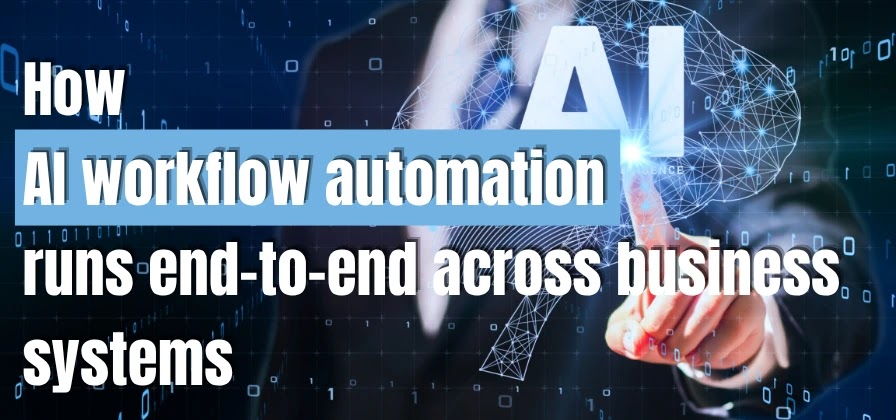
Traditional workflow vs AI-powered workflow - what actually changes
| Task | Manual workflow | AI workflow | |---|---|---| | Support ticket routing | Human reads and assigns each one | AI classifies, prioritises, drafts response instantly | | Invoice matching | Spreadsheet review, manual validation | Automated 3-way matching with exception flagging | | HR onboarding | Manual coordination across 4–5 teams | AI orchestrates tasks, sends documents, tracks completion | | Compliance checks | Periodic manual audit, high error rate | Continuous monitoring with real-time alerts | | Reporting | Hours of data pulling and formatting | Auto-generated from live data on a schedule | | Lead qualification | Sales team reviews every inbound manually | AI scores, enriches, and routes before human touch |How does an AI-powered workflow actually run?
1. Request arrives - Email, chat, form, or API. The AI receives input in any format without forcing the sender to follow a template. 2. AI classification - Intent, urgency, and category are identified using natural language processing in milliseconds. 3. Data pull - Account history, past interactions, and relevant policies are retrieved automatically from connected systems. 4. Resolution drafted - Generative AI produces a contextual response or executes the action directly against the right system of record. 5. Human review if needed - Edge cases, unusual patterns, and high-stakes decisions are flagged for human approval only. 6. Action completed and logged - Response sent, outcome recorded, data fed back into the system for continuous improvement.