
How to Choose the Best Mobile App Development Company
You have an app idea, a budget, and a spreadsheet with ten development agencies. Every proposal looks polished. Every portfolio boasts clean screens, five-star client reviews, and promises of “scalable iOS and Android apps delivered in twelve weeks.”
Yet, over 80% of consumer and enterprise mobile apps fail within their first year. Most don’t fail because the idea was bad - they fail because the founders hired an agency that built a brittle wrapper, ignored background memory limits, used cheap cross-platform hacks, or got rejected by Apple’s App Review team three days before launch.
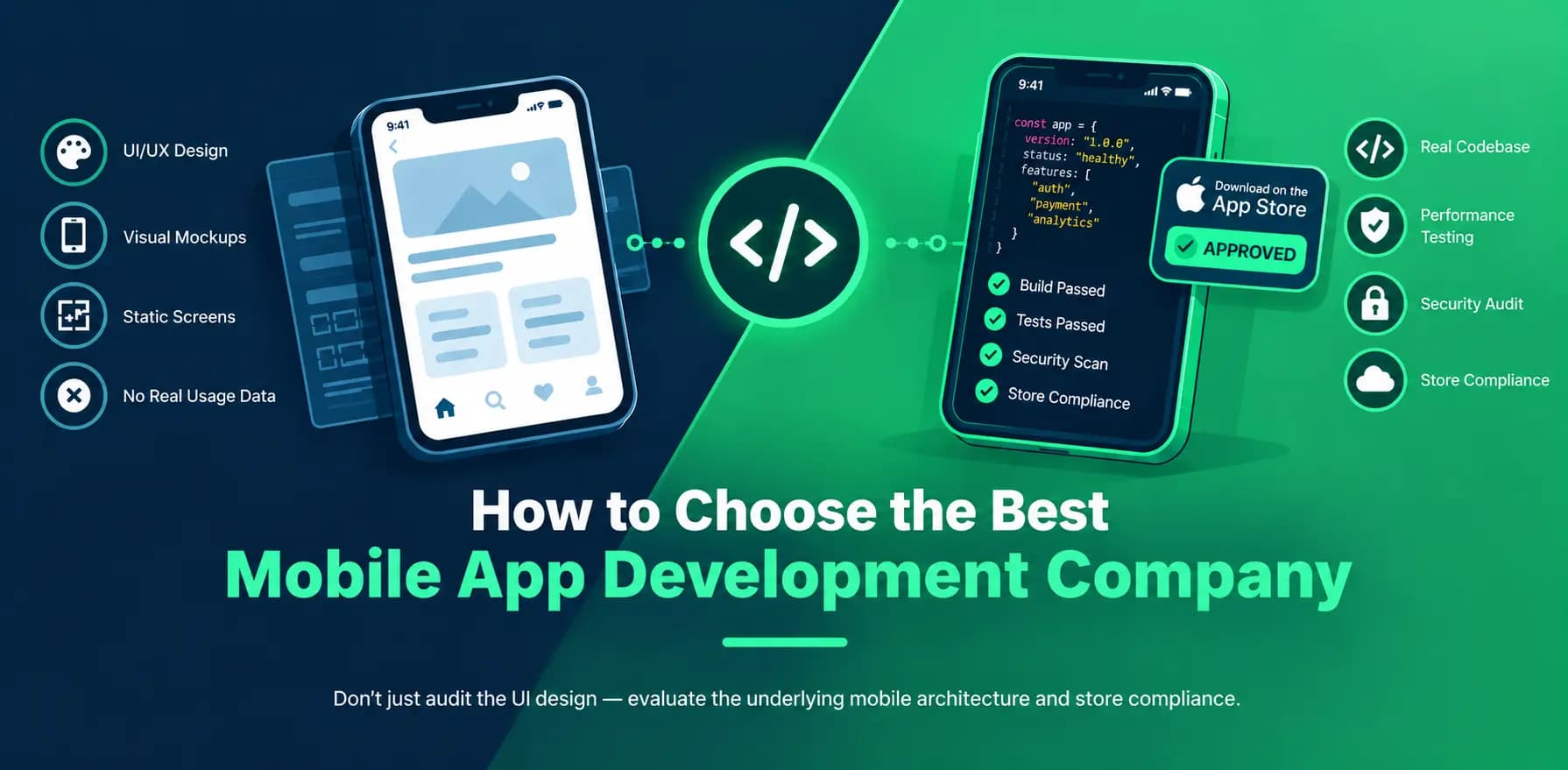
Knowing how to choose a mobile app development company isn’t about picking the agency with the prettiest Dribbble shots. It’s about auditing how they handle API latency, device fragmentation, push notifications, offline states, and post-launch OS updates.
If you are currently shortlisting vendors, this guide cuts through the sales pitches to help you vet engineering real-world capabilities before signing a contract.
Quick answer: To choose the best mobile app development company, skip the static portfolio slides and test their production apps on real devices. Audit their stance on cross-platform frameworks (React Native vs. Flutter vs. Native), insist on written guarantees for App Store and Play Store approvals, verify that daily code commits land in a repository you own, and confirm their SLA for annual iOS/Android OS updates. Avoid agencies that quote flat fees without clear architectural specifications.
1. Test Their Live Apps on Real Devices (Not Screenshots)
Anyone can hire a designer to create beautiful Figma prototypes. What matters is how their published apps perform when a user enters an elevator and loses 4G, or when 5,000 users trigger simultaneous push notifications.
Ask every agency on your shortlist for links to three live apps they built that are currently on the Apple App Store and Google Play Store. Download them.
- Look for smooth animations: Does the screen stutter when scrolling heavy lists?
- Test offline states: Turn off Wi-Fi and mobile data. Does the app crash, or does it handle offline gracefully with cached data?
- Check battery & memory usage: Does the phone get hot after five minutes of use?
Red flag: The agency claims they “can’t share links due to strict NDA” for every single project. Reputable agencies always have public case studies they can share.
2. Demand Honesty on Native vs. Cross-Platform Stacks
Many agencies push whatever tech stack their available developers happen to know, rather than what your app actually needs.
If an agency tells you “React Native is always better” or “Native iOS is the only way,” they aren’t consulting - they’re clearing bench capacity.
- Cross-Platform (React Native / Flutter): Excellent for 90% of business apps, MVP launches, e-commerce, and content platforms. Saves 30–40% in development costs while delivering near-native performance.
- Native (Swift / Kotlin): Necessary if your app requires heavy background processing, custom Bluetooth/IoT integrations, complex AR/VR features, or intensive graphics rendering.
If your project demands high-speed cross-platform performance, verify whether the agency has dedicated experienced React Native developers or specialized Flutter developers rather than generalists who learned the framework last month.
3. Require Written Guarantees for App Store & Play Store Approvals
Getting an app written is only half the battle. Getting it approved by Apple’s App Review team and Google’s automated policies is where inexperienced agencies freeze. Apple rejects roughly 30% of app submissions every week due to privacy policy oversights, broken in-app purchases, or improper background location usage.
Ask the vendor: “Is App Store submission included in the scope, and what happens if Apple rejects the app?”
Red flag: An agency that considers their job done the moment they hand over a .apk or .ipa build file. Your contract must state that final milestone payment is tied to successful store deployment.
4. Audit Their Mobile Backend & API Architecture
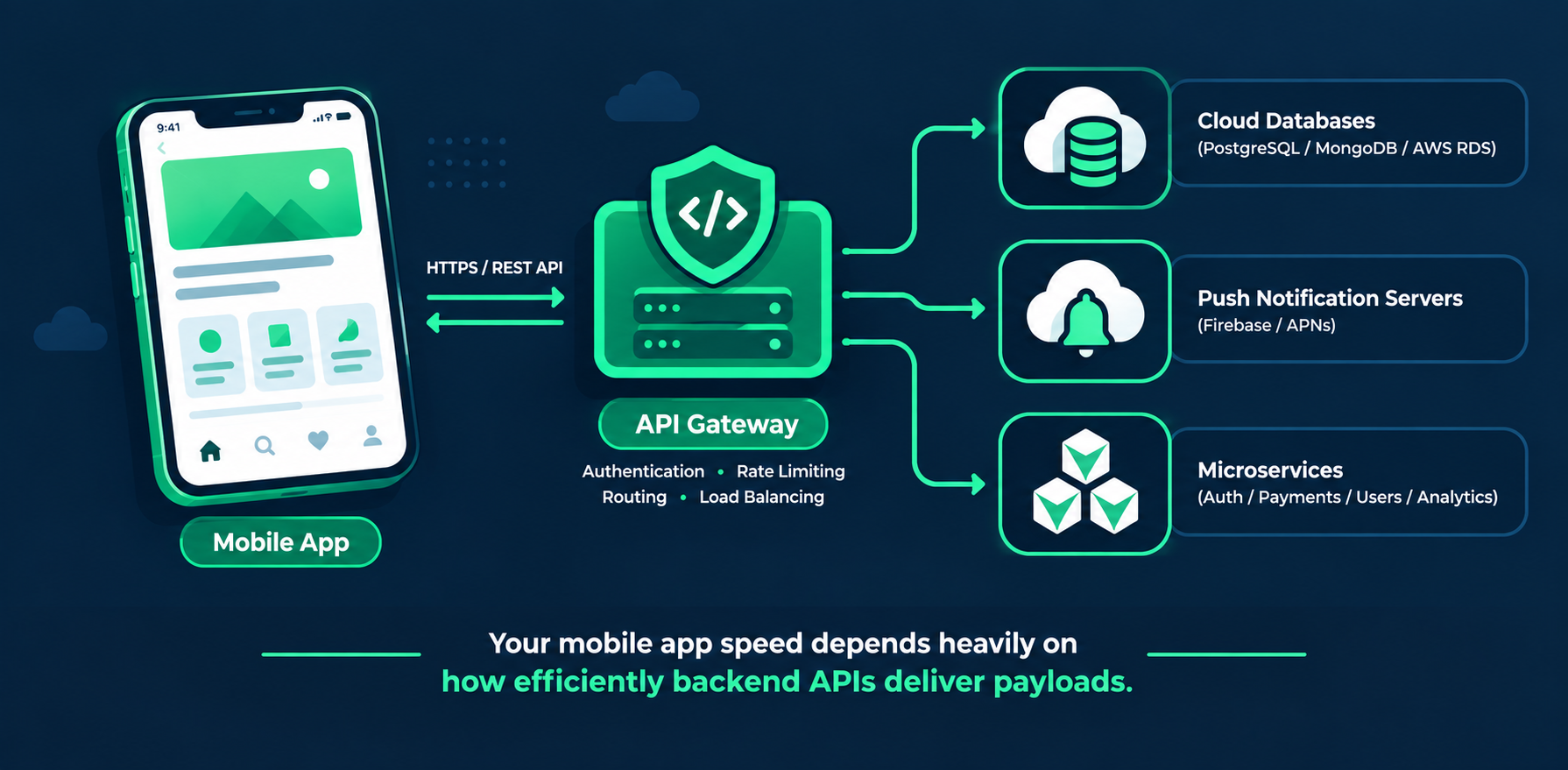
A mobile app is only as fast as the server APIs feeding it. If an agency builds a gorgeous mobile UI but connects it to slow, unindexed database queries, your app will feel sluggish regardless of how fast the user’s phone is.
Ask their lead architect how they optimize API payloads for mobile networks. Look for modern patterns like GraphQL, RESTful caching headers, and WebSockets for real-time features. If you are building a complex web and mobile product together, ensure their backend engineering matches custom mobile app development standards for long-term scalability.
5. Verify Real Device Testing Setup
There are over 24,000 distinct Android device models on the market today, featuring different screen ratios, chipsets, and OS customizations (Samsung OneUI, Xiaomi MIUI, Pure Android).
If an agency tells you they test exclusively on software simulators (Xcode Simulator / Android Studio Emulator), your users will discover camera bugs, notification drops, and layout breaks that simulators fail to catch.
What to ask: “How many physical devices do you test on before every release?” Professional mobile dev shops use physical device labs or cloud testing platforms like AWS Device Farm or BrowserStack to run automated UI tests across dozens of real phones.
6. Daily Code Ownership & Git Access
You should never have to wait until the end of a three-month project to see your codebase. From Day 1 of sprint work, code should be pushed daily to a Git repository (GitHub, GitLab, Bitbucket) owned by your company account.
This gives you full visibility into development activity, code commit history, and test coverage. It also ensures that if your relationship with the agency sours, your IP remains secure.
Red flag: The agency insists on hosting the repository on their private server and promises to “transfer the code upon final payment.” This creates massive vendor lock-in risk.
7. Understand What Mobile App Development Actually Costs
Mobile app quotes vary wildly. One agency quotes $8,000; another quotes $60,000 for the exact same feature list.
Understanding what mobile app development actually costs in India comes down to team composition. An $8k quote usually means one freelancer working without QA engineers, security testers, or UI/UX designers. A professional agency quote covers project managers, specialized backend devs, mobile devs, QA testers, and DevOps engineers.
If you are a startup working with limited capital, focus on building an MVP mobile app first. Scope down to 3 core features done exceptionally well, rather than 20 half-baked features.
8. Lock Down the Post-Launch OS Update SLA
Every September, Apple releases a new version of iOS. Every autumn, Google updates Android. These updates routinely break older APIs, push notification permissions, and UI layouts.
If your agency doesn’t offer post-launch maintenance, your working app could stop functioning for users overnight following a system update.
Ask for their post-launch SLA terms:
- What is the warranty period for fixing post-launch bugs? (60–90 days is standard)
- What is the monthly cost for ongoing OS compatibility updates and security patches?
Green Flags vs. Red Flags: Mobile App Vendor Checklist
What Great App Agencies Do | What Risky App Agencies Do |
|---|---|
Provide live App Store links to test on real phones | Show static Figma screenshots or video demos only |
Recommend tech stacks based on your specific app requirements | Force one framework because it’s their only available bench |
Include App Store approval & rejection handling in the scope | Deliver raw build files and leave store submission to you |
Run automated tests across real physical devices | Test exclusively on computer desktop emulators |
Commit code daily to your private GitHub repository | Host code on private servers until the final invoice is paid |
Include a 60–90 day post-launch bug warranty | Charge hourly rates for bug fixes starting on Day 1 after launch |
City-by-City Audit: Selecting App Developers Across India
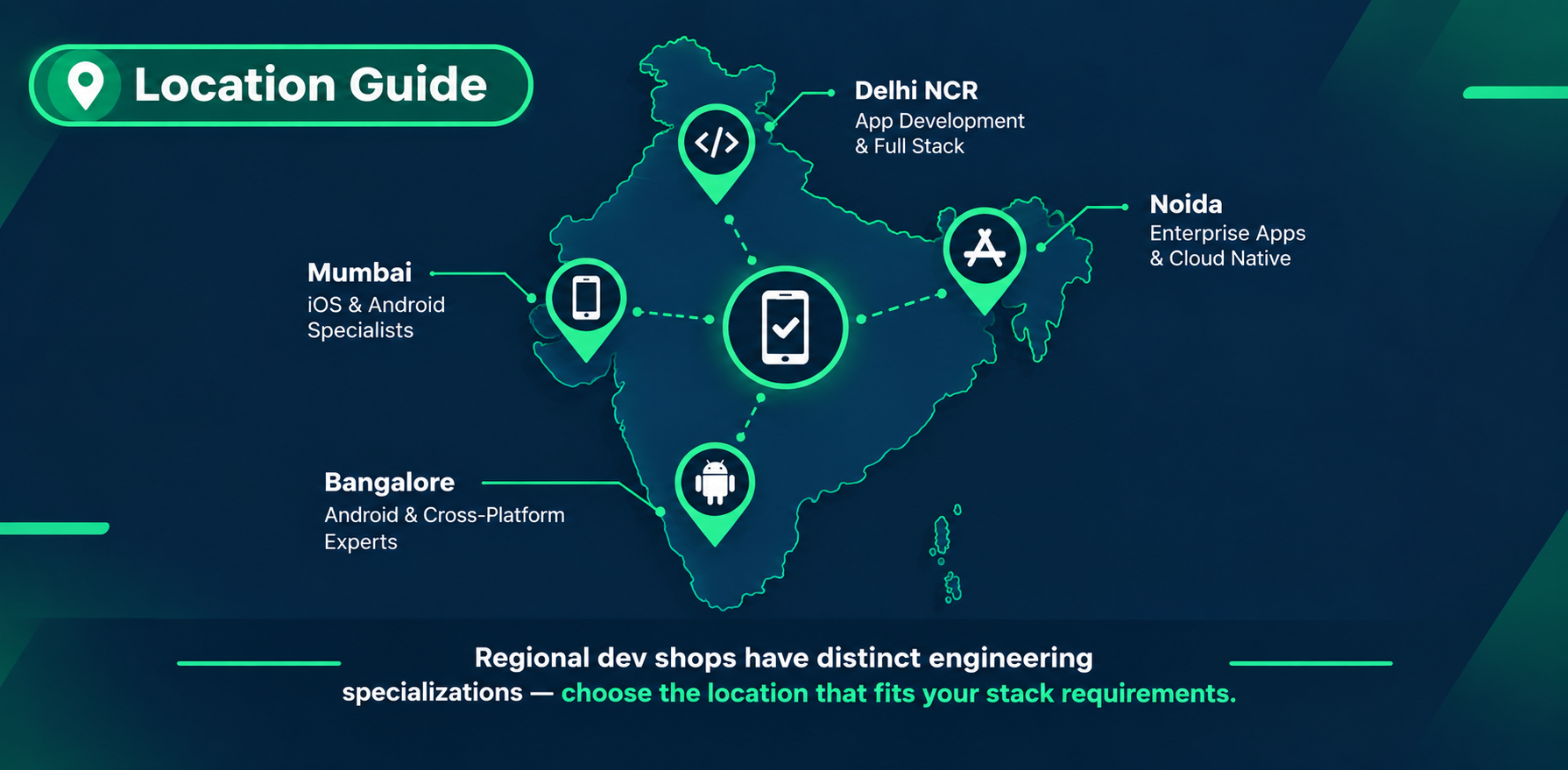
Selecting the right city for your app development partner impacts your budget, talent quality, and communication quality:
Noida & Delhi NCR: Known for strong cost-to-performance efficiency in consumer apps, e-commerce, and enterprise cross-platform builds. Check out our Noida vs Gurugram tech ecosystem breakdown to understand regional talent and overhead differences. Our specialized Noida mobile app engineering team and Delhi NCR mobile development services focus on high-scale cross-platform architecture.
Bangalore: Home to deep-tech mobile engineering teams experienced in complex SDKs, fintech payment pipelines, and high-concurrency app backends. Expect 25–30% higher development rates.
Mumbai: Ideal for fintech, banking, and media/OTT mobile applications requiring strict security compliance and real-time streaming infrastructure.
How Toadster Builds Mobile Apps
At Toadster Technologies, we build mobile applications designed to handle real-world scale, spotty network conditions, and rapid user growth.
We don’t hide behind static mockups or bloated dev teams. From Day 1, our engineers commit clean, documented code to your private repository. We run automated device testing across physical hardware, handle the entire App Store and Play Store submission process, and back our builds with explicit post-launch SLAs.
Explore our mobile app case studies to see live apps we’ve delivered for startups and global enterprises.
Selecting a mobile app development partner isn’t about finding the lowest hourly quote. It’s about securing an engineering team that understands app performance, store guidelines, and security architecture - ensuring your product succeeds long past launch day.